






Contact Springs
Definition:
Springs used for electric connectivity. They are usually conical/tapered springs.
Contact springs are the conical/tapered springs you see in battery compartments inside remote controls and other battery-powered applications, devices, and mechanisms. The things that must be considered when looking to buy conical contact springs are the physical dimensions and material type. The material type plays a big factor since it has to be conductive.

The first thing you must take a look at is that the contact spring’s coils make a telescope effect so that the battery will fit in its place. This means that the smaller coils’ outer diameter will compress into the inner diameter of the larger coils. The telescope effect allows your spring to have a solid height the size of its wire diameter since the spring will technically be compressed flat. This way is how batteries are so easily installed into their specific compartments.

Then, you must take a look at the material type. The material type may vary because contact springs are actually plated in either copper or zinc to be more conductive. In most cases our customers decide to make their springs out of Music Wire ASTM A228 (which is the most common and economical material type) but they may also choose Stainless Steel 302 A313, Phosphor Bronze Grade A B159 or Beryllium Copper B197. Gold is highly conductive and will definitely work when the contact springs are in use but it is a more expensive process since these springs can't be barrel plated and more labor is required to have them plated. This means that the labor put into the plating of these springs is another factor in the already high gold plating price.
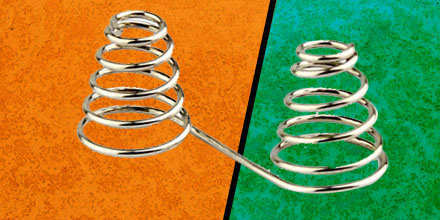
Contact springs may also be double since there needs to be a positive and negative side for some applications, such as battery compartments. These springs are basically a conical spring connected to a fully compressed conical spring or spiral spring. In other cases, they are simply two conical springs connected. These may be used when you're using a larger battery so both are positive/negative.