







Spring Makers: Custom Spring Manufacturing
Definition:
Persons or Companies who work in the production of coil springs such as compression springs, extension springs, torsion springs, conical springs, garter springs, barrel springs, magazine springs, and gun springs.
Spring makers work on lathes or automatized CNC spring machines. Acxess spring manufactures their springs on CNC machines. These are worked on by highly experienced spring technicians. In order to start the production of each spring, they are provided with spring specifications along with a blueprint indicating the tolerances the customer specified as well as material type. Spring makers at times may need to perform secondary operations such as bends (on torsion spring designs), hooks (on extension spring designs), or grinding (on compression spring designs). Our manufacturing capabilities go from micro wire diameters like 0.006” to large wire diameters like 1.000”.
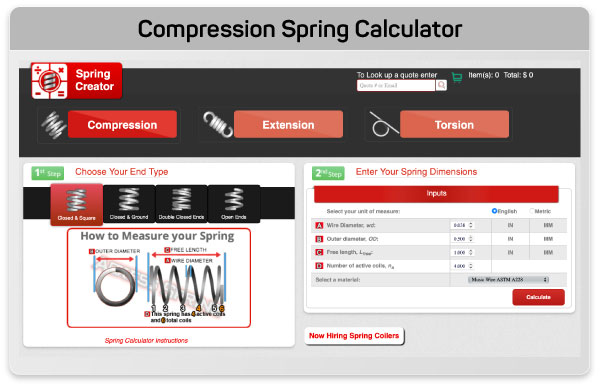
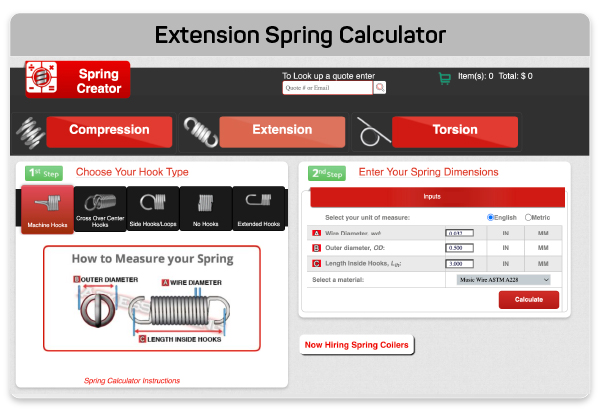
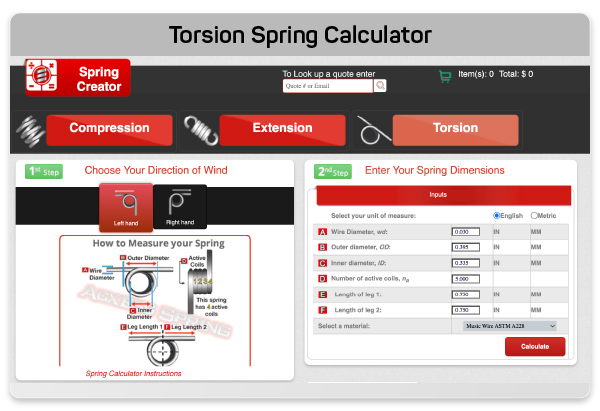
Design your spring using our spring maker software, Spring Creator. Here you are able to design compression, extension, or torsion springs. Calculate your spring’s physical dimensions as well as its load and travel capacities. Also, receive a full spring analysis containing all this information along with a live blueprint of your spring design. But before going on to doing your design, learn the basic spring design steps specified below.
Step 1.
What Material is Best For Your Design?
Knowing what material will resist your application's environment and which is the most economical choice can be tricky. Visit our “Properties of Common Spring Materials” page for information on which wire type will be best for your application. We offer many variations of spring wires. These are listed below:
- Music Wire
- Chrome Silicon
- Stainless Steel 316
- Stainless Steel 302
- Stainless Steel 17-7
- Phosphor Bronze
- Hard Drawn
- Beryllium Copper
- Oil Tempered
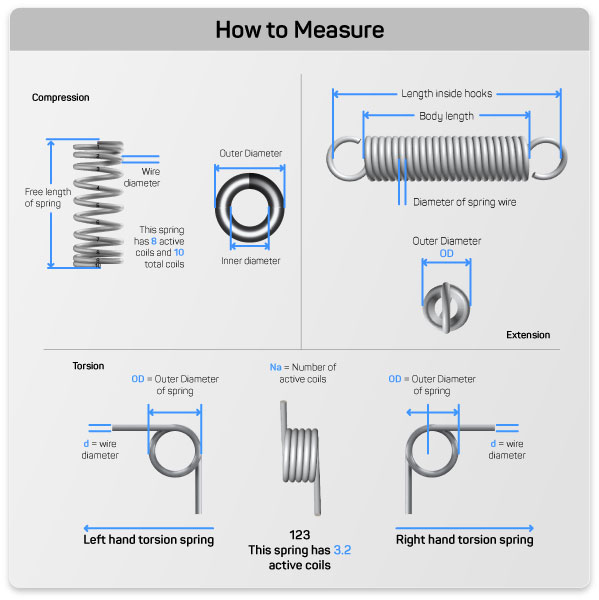
How to Measure Diagrams for Spring Makers:Compression, Extension and Torsion Springs
Step 2.
What Tolerances Should Your Design Have for its Physical Dimensions?
To know what physical tolerances your spring should have you must measure the parameters in which the spring will go into. Whether it is in a hole, over a shaft (mandrel), or both. Once you have measured these parameters you will know what restrictions you may have when it comes to your spring’s outer and inner diameters. Your spring’s free length also has a lot to do with its functionality on your device. If it is too long, your load may not be able to travel down to the desired loaded height because more travel implicates more force.
Standard Spring Tolerances
| Outer and Inner Diameter Tolerances | |
| Diameter | Tolerance |
| 0.051 to 0.075 | +/– 0.003 |
| 0.076 to 0.113 | +/– 0.004 |
| 0.114 to 0.240 | +/– 0.005 |
| 0.241 to 0.500 | +/– 0.008 |
| 0.501 to 1.000 | +/– 0.015 |
| 1.001 to 1.225 | +/– 0.020 |
| 1.226 to 1.460 | +/– 0.030 |
| 1.461 to 2.000 | +/– 0.040 |
| Free Length Tolerances | |
| Free Length | Tolerance |
| 0.001 to 0.500 | +/– 0.020 |
| 0.501 to 1.000 | +/– 0.025 |
| 1.001 to 2.000 | +/– 0.035 |
| 2.001 to 4.000 | +/– 0.075 |
| 4.001 to 8.000 | +/– 0.125 |
| 8.001 to 10.000 | +/– 0.175 |
Step 3.
Use Spring Creator to Design Your Spring
Now that you have what material type to use and the physical restrictions, you can go ahead and start designing your spring. Input dimensions into our spring calculator which are inside of the tolerances. Make adjustments as you go to meet your desired loads and rate. Once you’re done, click on “generate blueprint” to generate a real-time blueprint of your design along with your spring’s analysis. START NOW!.
Do you wish for your springs to be plated? No problem! We offer various plating types such as zinc (black, blue, clear or gold), black oxide (with or without wax), nickel plating, gold plating, phosphate or manganese coating.
Invest in precision and quality
Spring Creator 5.0 offers you the possibility to design springs that perfectly fit your needs. Our platform not only allows you to design various types of springs but also provides advanced tools like the Online Spring Force Tester to simulate and evaluate spring performance. Visualize your design in 3D, download detailed blueprints, and get instant quotes. Try it for free and discover why we are the preferred choice of engineers and makers!
Created by Alfonso Jaramillo Jr
President Acxess Spring
Over 40 Years of Experience in Spring Engineering and Manufacturing
Spring Makers: Custom Spring Manufacturing
Spring makers (like us at Acxess Spring) are specialists in custom spring manufacturing. They take metal wire and form it into precise, functional components. Whether it’s a tiny spring in a medical device or a heavy-duty coil in industrial equipment, spring makers use advanced tools and technical know-how to create exactly what’s needed.
More than just manufacturers, spring makers are problem solvers. They look at real-world challenges—like limited space, fluctuating loads, or environmental exposure—and create spring solutions that meet those needs. From prototyping to high-volume production, their role bridges design intent and physical functionality.
When the standard options don’t meet your requirements, customizing a spring offers more control over performance, size, and material. Here are common types of custom springs and how they’re typically used:


-
Compression Springs – Compress under load and return to their original shape. They’re found in pens, valves, and suspension systems.
-
Extension Springs – Stretch when pulled. They’re common in garage doors, trampolines, and machinery requiring return motion.
-
Torsion Springs – Twist under force, often used in clothespins, latches, or car trunk hinges.
-
Conical Springs – Tapered springs that compress into themselves, useful where space is limited.
-
Barrel Springs – Designed for stability, with a wider center and narrow ends.
-
Garter Springs – Circular springs used in sealing applications.
-
Magazine/Gun Springs – Engineered for precise movement in firearms or similar applications.
-
Wire Forms – Custom-shaped wire components that perform spring-like functions in unique assemblies.


Each type can be tailored in terms of wire size, shape, material, and load-bearing capacity. This flexibility makes it easier to adapt a design to specific performance goals or environmental factors, like temperature variation or exposure to moisture.
Spring manufacturing involves careful planning, accurate measurements, and specialized equipment. At Acxess Spring, the process is built around consistency and adaptability:
-
Reviewing the Design – Customers provide specifications or drawings. From rough ideas to CAD models, the goal is to define the springs function and constraints. Our engineers will often clarify intended use, allowable tolerances, and space limitations before moving forward.
-
Material Selection – Materials like stainless steel 302, music wire, chrome silicon, phosphor bronze, or beryllium copper are selected based on the operating environment and expected performance. For example, corrosion resistance, conductivity, or temperature range may be deciding factors.
-
CNC Coiling – Once the design is approved, CNC coiling machines form the wire into precise shapes. These machines ensure repeatability and accuracy, especially important in applications where multiple springs need to perform identically.
-
Inspection and Testing – Quality control involves both dimensional checks (using micrometers, calipers, etc.) and functional testing (verifying spring rate, load, and compression). Acxess Spring follows ISO 9001:2015 certified processes to ensure product reliability.
-
Shipping and Fulfillment – Once everything checks out, the order is packaged and shipped. Lead times vary by volume and complexity, but our systems are designed to scale efficiently from small prototype batches to large production runs.
The manufacturing process also allows for iterative improvement. If a prototype doesn’t meet expectations, we can adjust the wire size, coil count, or end configuration quickly and re-test the outcome. This flexibility is especially valuable in R&D environments or for one-off applications.
Designing a spring might sound technical, but with tools like Spring Creator 5.0, it’s more accessible than ever. This browser-based tool helps you calculate the dimensions and performance of a spring based on a few inputs.
Here’s how to use it:
1. Choose a Spring Type – Start by selecting whether you need a compression, extension, or torsion spring. The tool adjusts accordingly.


2. Enter Your Basic Requirements – Define core measurements like wire diameter, outer or inner diameter, free length, and total coils. If you're not sure about one of these, default ranges and tooltips provide guidance.


3. Select Material – Based on your use case (temperature, load, corrosion exposure), choose a wire material from options like stainless steel 302, music wire, or chrome silicon. Material properties are built into the calculations.


4. Define End Style – Choose the type of ends your spring should have—closed and ground, open, or hooks, depending on the spring type.


5. Run the Calculation – Spring Creator 5.0 will instantly generate specs including spring rate, solid height, load capacity, and max deflection. It also flags potential problems such as overstressing or underperforming designs.


6. Download or Share Your Results – You can save a detailed spring analysis report as a PDF, complete with dimensions and a blueprint. Share it with a manufacturer or colleague, or submit it for a quote.


What makes this tool especially helpful is its visual feedback and built-in error detection. You’ll see right away if your design pushes material limits or won’t compress correctly. This not only helps avoid mistakes, but also teaches you more about how springs function.
And because the tool is browser-based and free to use, it’s accessible for students, hobbyists, and professionals alike. Whether you’re designing a new prototype or just experimenting with ideas, Spring Creator makes it easy to explore possibilities.
Choosing to work with a professional spring manufacturer brings a number of advantages that go beyond simply producing parts:
-
Guidance on Design – Experienced engineers can help refine your initial concept to avoid issues like premature fatigue, coil bind, or incorrect fit. This input can prevent expensive revisions later in the project.
-
Reliable Quality – Manufacturers use precise machinery and certified processes to ensure that every spring performs consistently, especially in applications requiring tight tolerances or specific force output.
-
Material Versatility – Spring makers provide access to a broad range of materials, some of which may be difficult to source independently. Each material has distinct characteristics suited to different stresses, cycles, and environments.
-
Adaptability for Changes – If a spring needs to be modified—perhaps to increase force, reduce size, or fit a new assembly—a spring maker can quickly provide alternate designs or samples based on the original specs.
-
Efficiency and Scale – From single prototypes to thousands of units, manufacturers can scale production while maintaining accuracy. This helps reduce lead times and costs as your project moves from development to full production.
-
Documentation and Compliance – Professional manufacturers can provide test results, material certifications, and compliance documentation (e.g., RoHS, REACH, or ISO 9001:2015), which is important for many industries.
-
Support for Complex Applications – Whether it’s aerospace, robotics, electronics, or medical devices, spring makers understand how to align mechanical design with application requirements. Their experience adds insight to challenges you may not have anticipated.
Working with a spring maker is not just about getting a spring made—it’s about improving the reliability, efficiency, and performance of your overall system. It’s a collaborative process where your goals drive the solution, and where a good partner can help you get it right the first time.
Understanding the basics of spring design and manufacturing empowers you to make better decisions—whether you’re designing from scratch, iterating a prototype, or simply replacing a part that failed.
By working with a skilled spring maker and using tools like Spring Creator 5.0, you can take a more thoughtful approach to spring selection and integration. That means fewer surprises, better function, and components that actually match the real-world conditions they face.
5 Key Takeaways
-
Custom springs solve specific problems that off-the-shelf options can’t.
-
Spring makers handle many spring types, from compression to torsion to wire forms.
-
Designing a spring is manageable, even if you’re new to engineering.
-
Digital tools like Spring Creator 5.0 reduce guesswork and speed up development.
-
Collaborating with experienced manufacturers leads to better outcomes and fewer surprises during production.
If you’re working on something that requires a spring and want to explore your options or double-check your design, feel free to reach out. We’re always glad to answer questions or point you in the right direction.
Contact us to learn more or to begin reviewing your design.