





Definition: A guide to designing compression springs providing the user with several compression spring formulas and compression spring calculations which are required to achieve a functional compression spring design.
Are you in need of assistance on your compression spring design? At Acxess Spring, we’ve got you covered with this exceptional compression spring design guide. Besides our design guide, our website is also filled with technical articles which will also help you in designing a reliable compression spring which will work accordingly in your device or mechanism. Here you will be instructed to make all of the decisions required to design a compression spring; from material type and dimensions to your spring’s force and elasticity.
1.) Dimensions and Material Type
The first thing you must do, as shown on our spring calculator, Spring Creator, is set your compression spring’s physical dimensions and specifications. These don’t only include your compression spring’s measurements but also the end types and material type. First, measure your compression spring’s surroundings to make sure that the dimensions you decide upon will not affect the spring when actually being installed. If it is going over a shaft or hole, you must be vigilant on the inner and outer diameters. Make sure you have some clearance between your spring’s coil diameters and the walls of the hole/shaft or other mounting pieces that may intervene with the spring’s deflection in order to avoid damage caused by friction or impact on the coils. It is best for the spring to be pre-loaded so make sure that the free length of your spring is a bit longer than the distance from the base where the spring will be standing to the object that’ll be applying force. The compression spring design formulas to calculate its physical dimensions are provided below as well as how to choose a material type.
End Types
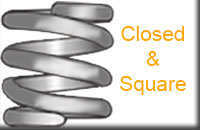
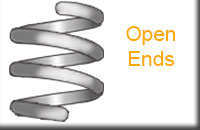
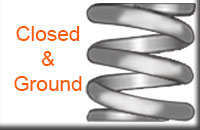
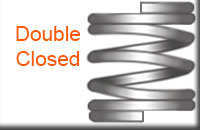
There are several types of compression spring ends types. The most popular ends are closed and squared ends. The other end types provided on our compression spring calculator are closed and grounds ends, double closed ends, and open ends. Changing the end types will affect your spring in stability and even force. This is because changing the end type and keeping the active coils the same will affect the total coil count or solid height. Affecting the coil count could result in force changes as well as specified on the later provided force chart.
Material Types
Choosing the material type of your compression spring is a very important compression spring design process because choosing the wrong material for your spring can either cause your spring not to work in the required environment or unnecessary costs. Unnecessary costs are bound to happen when selecting a material type if you picked an exotic material type while you could’ve used a more common wire type such as Music Wire ASTM A228 or Stainless Steel 302 A313. Your spring not working can be caused by not taking your spring’s environment into consideration when it comes to corrosion, high temperatures, or magnetic fields.
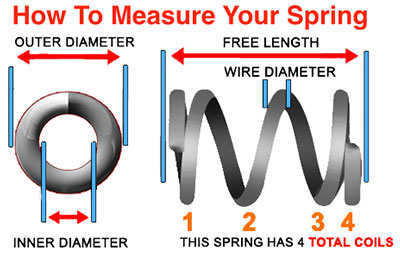
Compression Spring Design Guide Formulas
Outer Diameter: The outer diameter of your compression spring is calculated by adding two wire diameters to the inner diameter.
Inner Diameter + 2 Wire Diameters = Outer Diameter
ID + 2 WD = OD
Inner Diameter: The compression spring’s inner diameter is calculated doing the opposite; subtracting two wire diameters from the outer diameter.
Outer Diameter – 2 Wire Diameters = Inner Diameter
OD – 2 WD = ID
2.) Force and Elasticity
Your compression spring’s force is defined by its spring rate, also known as spring constant. This specification is expressed in load per distance traveled (lb/in or N/mm) which means that your compression spring’s distance traveled will depend on the load you apply and vice versa. The amount of load at a specific distance traveled are your spring’s working loads. Knowing these values will help you determine the spring rate you’re required to have in order for your spring to function as planned. The formula we’ve used on our calculator to calculate compression spring rate is the one provided to the right. As you can see, the spring’s physical dimensions and material type have a lot to do with how strong your spring will be.
Knowing your load and travel doesn’t necessarily mean you’re gonna be able to achieve it, though. Springs have an elastic limit which only allows you to travel a certain distance thus limiting your load as well. There are two different values for travel and load limitations. There is True Maximum Travel and Maximum Travel Considering Solid Height as well as there is True Maximum Load and True Maximum Load Considering Solid Height. These are both related to each other since the distance your spring travels is proportional to its load. True Maximum Travel is a possible amount of travel. This means that you’re able to get that much travel if you were to make your compression spring’s free length longer. The Maximum Travel Considering Solid Height, on the other hand, is the amount of travel you’re gonna get out of the spring design you have now. If the True Max Travel is higher than the Maximum Travel Considering Solid Height, you’ll be able to extend the free length and your compression spring will also be able to travel down to solid height. If they are the same, it means your spring has reached its limit and its free length cannot be extended because you’re already getting all of the travel the spring can achieve with its current dimensions. That would be your compression spring’s maximum compression. The same goes for the True Maximum Load and Maximum Load Considering Solid Height. The formulas to calculate your required rate and working loads are provided below.
Compression Spring Formula Guides
To calculate the amount of rate on a compression spring design based on physical dimensions including material type use the formula provided below:
k = Gd^4 / 8D^3N
Explanation of Symbols:
- d = Wire Diameter
- D = Mean Diameter
- N = Active Coils
- G = Shear Modulus of Material
- K = Spring Constant
G-Value for Common Spring Materials
- Music Wire = 11.5 x 10^6
- Stainless Steel = 11.2 x 10^6
- Phosphor Bronze = 5.9 x 10^6
- Monel = 9.6 x 10^6
- Inconel = 11.5 x 10^6
- Copper = 6.5 x 10^6
- Beryllium Copper = 6.9 x 10^6
Calculate Required Spring Rate
To calculate your compression spring’s rate (k) you must divide your spring’s load (L) by the distance traveled (T).
Rate = Load ÷ Travel
k = L ÷ T
Calculate Working Loads
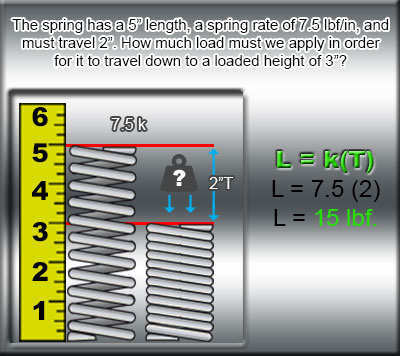
To calculate your compression spring’s load (L) at a certain distance traveled you must multiply the spring rate (k) by that distance traveled (T).
Load = Rate x Travel
L = kT
Calculate Distance Traveled
To calculate the distance traveled (T) under a certain load, you must divide the compression spring’s load (L) by the spring rate (k).
Travel = Load ÷ Rate
T = L ÷ k
Compression Spring Design Guide
Table of Contents
- What is a Compression Spring?
- What Decisions Are Fundamental to Design a Spring?
- How Do Different End Types Influence Spring Performance and Stability?
- Why Is Material Selection Essential, and Which Materials Are Commonly Used?
- How Do You Determine the Required Force and Elasticity of a Compression Spring?
- What Are the Key Equations for Calculating to Design a Spring?
- How Do You Determine Inner and Outer Diameters?
- How Do You Calculate the Spring Rate?
- Can We See a Practical Example of a Spring Design Calculation?
- What Additional Tips and Best Practices Can Improve Your Spring Design?
- How Can You Conclude Your Compression Spring Design Journey with Confidence?
What is a Compression Spring?
A compression spring is a helical shaped coil spring made of round wire with pitch in between the coils to enable the compression spring to compress when force is applied. Compression springs are one of the most common types of springs you’ll encounter. When you apply a force to a compression spring, it “compresses” and stores potential energy. Once that force is released, the spring expands back to its original length. This makes compression springs invaluable in countless applications—from automotive suspensions and mattresses to tiny electronic switches and door latches.
But designing a compression spring that matches your exact requirements involves more than simply picking a wire diameter and coil count. You need to consider factors like the spring’s working environment, the material’s properties, the relationship between load and deflection, and how the spring’s shape and dimensions affect its performance. That’s why we’ve created this detailed guide—to empower you to design a compression spring that truly fits your needs.


What Decisions Are Fundamental to Design a Compression Spring?
Before you get into the nitty-gritty of load and deflection, the first step in designing a compression spring is to clarify your spring’s physical dimensions and materials. This stage involves selecting wire diameter, inner and outer diameters, total coils, and free length. It also includes determining the end type best suited for your application, as well as choosing a material capable of withstanding the environment it will be exposed to.
In practical terms, start by measuring the space the spring will occupy. If the spring must fit over a shaft, make sure its inner diameter (ID) is large enough to avoid scraping and friction over the shaft or rod. If it must fit inside a hole, ensure the outer diameter (OD) is small enough to leave some clearance in the hole. A tight fit might lead to coil rubbing and premature wear, while a loose fit might reduce stability. Similarly, you’ll want to select a free length that allows for a slight preload, ensuring the spring remains stable and engaged even at its resting position.


Material choice is equally critical. The type of wire you select affects not only the spring’s performance but also its longevity, environmental resistance, and cost. An environment with high humidity or corrosive chemicals might require stainless steel or specialty alloys. A warm, controlled indoor environment might allow you to use a more economical Music Wire. Understanding these factors ensures that you don’t overshoot costs by selecting an unnecessarily “exotic” material, nor underperform by using a material unsuited to your conditions.
How Do Different End Types Influence Spring Performance and Stability?
Compression springs don’t always share the same coil termination style. The end type of a spring influences how it sits in its assembly, affects the total coil count, and can slightly alter load characteristics. Common end types include:
- Closed and Squared Ends: Both ends of the spring have coils that touch, making the end coil perpendicular to the axis. This configuration provides a stable base, ensuring the spring stands upright and transfers load evenly. This end type is the most economical.
- Closed and Ground Ends: Similar to closed and squared, but here the end coils are also ground flat. This gives the spring an even more stable resting surface, improving its accuracy in load application and reducing tilt during compression.This end type is more expensive due to the additional grind operation that has to be performed on the ends.
- Double Closed Ends: Both ends are closed, which can increase the spring’s stability under load, making it suitable for applications where alignment is crucial. This end type does not add any cost to your spring.
- Open Ends: The coils at the ends are not closed. This end type is for getting less solid height and more travel out of your spring. This end type needs preload so the open ends of the spring are not floating and do not buckle.
Selecting the right end type depends on the level of stability and accuracy required. For critical applications requiring precise load characteristics and minimal buckling, closed and ground ends are often preferred. For less critical uses where cost and simplicity matter more, open ends might suffice.
Why Is Material Selection Essential, and Which Materials Are Commonly Used?
Choosing the appropriate material type ensures your spring can handle its working environment while also aligning with cost and performance goals. For instance, a spring operating in a high-temperature setting will need a material resistant to heat-induced weakening. Alternatively, a device exposed to moisture, salt spray, or chemicals might need a corrosion-resistant alloy.
Some commonly used materials include:
- Music Wire (ASTM A228): A high-quality, carbon steel wire offering excellent tensile strength and cost-effectiveness. This is often used for springs that require high loads in relatively controlled environments.
- Stainless Steel 302 (A313): A corrosion-resistant option that can handle humid or moist conditions. Although slightly less strong than Music Wire, its resistance to rust and staining makes it a go-to choice for many outdoor or wet applications.
- Phosphor Bronze, Beryllium Copper: Useful in situations where electrical conductivity or non-magnetic properties are desired, such as sensitive electronic assemblies.
The goal is to match your spring material to the environment, performance requirements, and budget. Don’t assume that “exotic” always means “better.” Often, a well-selected common alloy meets your needs while keeping costs down.
How Do You Determine the Required Force and Elasticity of a Compression Spring?
Once you’ve set your dimensions and chosen a material, the next big step is to determine how much load the spring should carry and how far it should compress under that load. This involves understanding the spring’s “rate” (k), also known as the spring constant. The rate defines how much force is needed to compress the spring by a certain distance, and is typically expressed in pounds per inch (lb/in).
If you know you need the spring to compress half an inch (0.5 in) under a 10 lb load, the rate must be 10 lb ÷ 0.5 in = 20 lb/in. This ensures that every additional inch of compression requires 20 lbs of force. Conversely, if you have a known rate, you can quickly find out how much the spring will compress under a given load.


However, it’s not enough to know the desired load and travel. Springs have elastic limits—points beyond which they cannot compress without risking damage or permanent deformation. There are two critical travel limitations:
- True Maximum Travel:
Think of this as the “absolute max travel” limit. It represents the most the spring could compress if there were no physical space constraints. In other words, if you were willing to redesign the spring—perhaps by making its free length longer—you could, in theory, achieve this much travel. It’s a number that tells you the material and geometry are capable of more travel than you’re currently using, but you’d have to modify the spring’s dimensions to get there.
Understanding these values helps guide your design decisions. If the True Maximum Travel is less than what you currently have, it means you could redesign the spring (for instance, by increasing its free length) to allow more compression. If both values match, you’ve already reached the design’s maximum allowable compression. In a nutshell, the True Maximum Travel is the maximum amount of travel deflection you can induce on a compression spring. By finding a suitable balance between spring rate and allowable deflection, you ensure the spring functions reliably without being over-stressed.
What Are the Key Equations for Calculating to Design a Spring?
Springs may seem like simple mechanical elements, but they rely on well-established formulas. To design effectively, you must understand how to use these equations:
Calculating Required Rate: If you know the load (L) needed at a certain travel (T), the rate (k) is:
k = L ÷ T
For instance, if a 15 lb load causes 2 in compression:
k = 15 lb ÷ 2 in = 7.5 lb/in


Calculating Working Loads: If you already have a rate (k) and know the travel (T):
L = k × T
For a spring with k = 7.5 lb/in compressed by 2 in:
L = 7.5 lb/in × 2 in = 15 lb


Calculating Distance Traveled: To find how far a spring will compress under a certain load:
T = L ÷ k
If L = 10 lb and k = 5 lb/in:
T = 10 lb ÷ 5 lb/in = 2 in


Understanding and applying these formulas helps you predict how your spring behaves under various scenarios, ensuring you design it to meet your exact specifications.
How Do You Determine Inner and Outer Diameters?
When refining the dimensions of your spring, you’ll need to understand the relationships between inner diameter (ID), outer diameter (OD), and the wire diameter (d):
Calculating Outer Diameter from Inner Diameter:
If you start with the inner diameter (ID) and know the wire diameter (d), you can find the outer diameter (OD) by accounting for two thicknesses of wire—one on each side of the coil:
OD = ID + 2d
For example, if you have a spring with an ID of 0.5 inches and a wire diameter of 0.05 inches, you can plug these into the formula:
OD = 0.5 in + 2(0.05 in) = 0.5 in + 0.1 in = 0.6 in
This calculation ensures that the outer diameter incorporates the total thickness of the spring’s wire on both sides.
Calculating Inner Diameter from Outer Diameter:
Sometimes you’ll start from the other end, knowing the outer diameter and wanting to find the inner diameter. Using a similar relationship, simply subtract two wire diameters from the outer diameter:
ID = OD - 2d
For instance, if you know your spring’s OD is 0.6 inches and your wire diameter is still 0.05 inches:
ID = 0.6 in - 2(0.05 in) = 0.6 in - 0.1 in = 0.5 in
This ensures that the inner diameter calculation properly accounts for the thickness of the coil material.
By mastering these fundamental geometric relationships, you’ll ensure that your compression spring not only performs mechanically as intended—supporting the correct loads and deflecting the right amounts—but also physically fits into the designated space. Proper sizing and dimensioning help prevent premature wear, noise, excessive friction, and even complete malfunction, ultimately contributing to a reliable, high-performing end product.
How Do You Calculate the Spring Rate?
If you need to calculate the spring rate from scratch using the spring’s physical parameters, use the following formula:
k = (G * d^4) / (8 * D^3 * N)
Where:
- d: Wire diameter (in inches)
- D: Mean coil diameter, often calculated as (OD + ID)/2 or simply (OD - d)
- N: Number of active coils
- G: Shear modulus of the material (in psi for English units)
The value of G varies by material. For example:
- Music Wire ≈ 11.5 x 10^6 psi
- Stainless Steel ≈ 11.2 x 10^6 psi
- Phosphor Bronze = 5.9 x 10^6
- Copper = 6.5 x 10^6
- Beryllium Copper = 6.9 x 10^6
This equation shows how sensitive the spring rate is to the wire diameter and the number of coils. Increasing wire diameter or reducing the number of coils generally raises the rate, making the spring stiffer. Larger mean diameters or more coils reduce stiffness.
Can We See a Practical Example of a Spring Design Calculation?
One of the best ways to solidify your understanding of compression spring design is to walk through a real-world scenario. Let’s construct a hypothetical situation and go step-by-step through the thought process, calculations, and adjustments you might make along the way. While this example is simplified, it mirrors the considerations you would tackle when designing an actual spring for a specific application.
Scenario:
Let’s imagine you’re working on a small handheld mechanism—perhaps a specialized pen-like tool or a miniature valve—that requires a very light but precise pushing resistance. You know the spring inside this mechanism needs to provide a specific load and fit into a tight space. Here’s the scenario:
Performance Requirements:
- Load and Travel: The spring must provide a load of 4.545 pounds (lb) when compressed by 0.5 inches (in). From this requirement, you’ve established that the spring’s rate (k) must be 9.09068 pounds per inch (lb/in). This ensures that at half an inch of compression, the spring will reliably deliver the needed 4.545 lb of force.
- Dimensional Constraints:
The spring must fit inside a hole with an inner diameter of 0.44 inches. To prevent friction and potential binding, the spring’s outer diameter (OD) must be slightly smaller than 0.44 inches, leaving enough clearance for smooth operation.
Additionally, the spring’s Free Length (the length of the spring with no load) cannot exceed 1.420 inches. Staying within this maximum length ensures the spring fits properly in the assembly, without introducing unnecessary preload or crowding other components.
Wire Diameter and Material:
To achieve the desired strength and durability, you’re using a 0.047-inch wire diameter. This size provides a robust, reliable coil that can handle the required load cycle after cycle. Given the moderate operating environment, Music Wire (ASTM A228) is an excellent choice. It’s strong, fatigue-resistant, and widely available, making it a cost-effective solution for this type of precision application.
Bringing It All Together:
With a wire diameter of 0.047 inches and the requirement that the OD must be less than 0.44 inches, you’ll start by estimating a coil diameter that allows for sufficient clearance. For instance, if you choose a target OD of about 0.43 inches, that gives a 0.01-inch margin—enough to avoid coil-to-wall contact in most cases.
Now that you have an idea of the basic requirements, you can start a search using Spring Finder 5.0:


Testing Using Online Spring Force Tester:
Once you decide on Stock Part Number PC047-437-15000-MW-1410-C-N-IN, the next step is to verify that the spring performs as intended:
- Load and Deflection Test with Online Spring Force Tester:
Using Acxess Spring’s Online Spring Force Tester, compare the measured force against the required values. You should input a load of 4.545 lbf to automatically calculate the deflection of the spring under that load. - If the measured force at 0.5 inches is slightly off, small iterative adjustments can be made to the design (e.g., tweaking coil count, mean diameter, or end treatments). Typically, however, a well-calculated design using Music Wire at the given dimensions will be on target.
By starting with a specific load and travel requirement, determining the necessary spring rate, and working within defined spatial constraints, you can use a fixed wire diameter of 0.047 inches and Music Wire material to produce a spring that perfectly meets your application’s needs. With the Stock Part Number PC047-437-15000-MW-1410-C-N-IN spring in hand, verifying performance is straightforward using the Online Spring Force Tester, ensuring the final product delivers 4.545 lbf at 0.5 inches of compression, just as intended.


Why Should You Consider Using Online Tools?
Calculations on paper can be time-consuming and prone to human error. That’s why using online tools like Acxess Spring’s Spring Finder 5.0 and the Online Spring Force Tester can be a game-changer. With these tools, you can:
- Quickly Iterate Designs: Input your desired outer diameter, free length, total coils, and material to calculate load, deflection, and more within seconds.
- Validate Real-World Springs: By measuring the load at a given compression and comparing it against your required values, you can confirm whether your spring matches the intended design. If it doesn’t, you can fine-tune your parameters and try again.
- Save Time and Money: By verifying designs before mass production, you avoid costly errors and ensure that the final spring will perform as needed. This reduces the risk of delays and wasted materials.
These tools not only streamline the design process but also help you gain confidence in your final product before committing to large production runs.
What Additional Tips and Best Practices Can Improve Your Spring Design?
Designing an effective compression spring involves more than just crunching numbers. Here are some practical tips to help you create a better product:
- Start with Standard Sizes:
Whenever possible, pick common wire diameters and materials that are readily available. Try In Stock Compression springs form the spring store that come in standard sizes simplify sourcing and reduce lead times and costs. - Leave a Safety Margin:
Avoid pushing your spring to its absolute limit in travel or load. Operating too close to your maximum load, maximum travel or solid height repeatedly can cause fatigue, shorten spring life, and may lead to premature failure. - Test, Test, Test:
Use in stock compression spring prototype springs and test them early. Confirm that the load and travel match your calculations. If something’s off, make incremental adjustments until you achieve the desired performance. - Consult with Experts:
If your application has complex requirements—like extreme temperatures, large loads, or highly sensitive tolerances—consider reaching out to experienced spring engineers. Professional insights can help you avoid common pitfalls and achieve a reliable design more quickly.
How Can You Conclude Your Compression Spring Design Journey with Confidence?
Designing a compression spring might seem like a daunting task at first, but with the right approach, it becomes thoroughly manageable. You’ve seen how material selection, coil dimensions, and end types influence the spring’s performance. You’ve learned about the significance of the spring rate (k) and how to calculate load and travel. Not only that, but you’ve discovered how to balance maximum travel with elastic limits, and how tools like Acxess Spring’s online calculators and testers can streamline the process.
In essence, successful spring design merges theory with practical verification. Understanding the underlying formulas and concepts provides a solid foundation, while iterative testing and refinement ensure that the final product meets real-world demands. Armed with this knowledge, you’ll be able to make more informed decisions and design compression springs that offer consistent, reliable performance in your mechanism or device.
Five Key Takeaways:
- Accurate Dimensional Planning:
Before working on load and rate calculations, ensure your spring’s basic dimensions (wire diameter, inner/outer diameter, free length) fit the intended application space with appropriate clearances. - Proper Material Selection:
Choose a material based on your spring’s operating environment—considering temperature, corrosion resistance, and magnetic properties—to balance performance, longevity, and cost. - Mastering Spring Rate and Load Calculations:
Understanding the fundamental formulas for spring rate (k), load (L), and travel (T) is crucial. These calculations guide you in designing a spring that meets exact performance requirements. - Travel and Elastic Limits:
Recognize the difference between theoretical maximum travel and the actual travel limited by solid height. Ensuring that your spring operates within safe deflection limits prevents fatigue and early failure. - Utilizing Tools and Expert Guidance:
Leverage online calculators, testers, and professional advice to verify your design. By testing prototypes and making incremental adjustments, you can refine your spring until it perfectly matches your intended specifications.
Ready to take your spring design to the next level? Put theory into practice by using Acxess Spring’s Online Spring Force Tester to verify your spring’s load and deflection. Also, simplify your design process by inputting your data into Spring Creator 5.0, our advanced online spring calculator, to instantly see the results of design tweaks. These tools will help you confidently finalize your compression spring design and ensure it performs flawlessly in your application.
